Stake Casino Review 2026: Ratings, Games and Payouts
Stake scores 7.9/10 across eight editor-checked categories in 2026. Here is what earns that number, where it loses points, and what still needs real player reports to confirm.
Stake carries an overall score of 7.9 out of 10 on GetABonus, built from eight categories our team checked directly against the site's own terms, licence register and account tools. There is no player-reported data folded into that number yet — payout speed, support quality and the rest of the community-rated categories are still waiting on real reports, and none of them are published below three. That distinction matters, because it is the difference between a number an editor assigned from published policy and a number nobody can verify yet.
This review walks through all eight scored categories individually, what earns Stake its points and what costs it points, plus the parts of the platform — the VIP programme, KYC triggers, country restrictions — that sit outside the scoring system but decide whether Stake is actually usable where you live.
[[casino:3d636d80-a452-462a-8a00-13bc179efd79]]
How This Review Is Scored
GetABonus splits every casino rating into two halves, and it is worth understanding the split before reading any of the numbers below.
Checked by us covers what is the same for every visitor: the licence, the published terms, the game library, the account tools. One reviewer applies the same criteria to every casino, which is what makes the number comparable between operators. Stake has eight of these — licence and regulation, security and fair play, game selection, bonus terms, payment options, mobile experience, responsible gambling, and design and usability.
Reported by players covers what only someone who actually used the casino can know — how long a withdrawal really took, whether support helped, whether the games felt like enough once you were playing. None of these are scored until at least three people have reported, because one payout is an anecdote, not an average. As of this review, Stake shows zero submitted reports, so payout speed, customer support, bonus experience, and the player-side checks on game selection, mobile experience and design all read "not rated."
The overall 7.9 is a weighted average of the eight checked-by-us categories, with licence and regulation carrying the heaviest single weight because the regulator determines what recourse you actually have if something goes wrong. Once real player reports start coming in, the overall score will begin drawing on those too, and it will move as that data arrives.
Category | Score | Rated by |
|---|---|---|
Licence & regulation | 6.0/10 | Us |
Security & fair play | 8.0/10 | Us |
Game selection | 10.0/10 | Us |
Bonus terms | 6.0/10 | Us |
Payment options | 8.0/10 | Us |
Mobile experience | 10.0/10 | Us |
Responsible gambling | 8.0/10 | Us |
Design & usability | 9.8/10 | Us |
Full band definitions for each score are published on the how we rate page, so you can check any of these numbers against the criteria rather than take our word for it.
Why this review looks different from before
An earlier version of this review scored Stake across ten categories under a single blended "expert rating" per section, mixing what an editor could check from published terms together with what only an actual player experience could confirm. That approach had a real weakness: a support score, for instance, read as a single confident number even though nobody had actually reported a support interaction to weigh it against.
The current methodology fixes that by keeping the two apart. The eight scores in the table above are checked-by-us facts — the same for every reader, verifiable against Stake's own published terms and licence register. The six categories marked "not rated" further down are exactly that: unrated, honestly, until real players report enough experiences to average. Nothing here is estimated to fill a gap; a missing number stays missing until the data exists to support it.
Licence & Regulation: 6.0/10
Stake is licensed by the Curaçao Gaming Authority under license number OGL/2024/1451/0918, held by the operating entity Medium Rare N.V., which lists a Curaçao head office. That licence is verifiable in the public register, and Stake also runs locally regulated entities in a small number of specific regional markets outside the core Curaçao licence.
A 6.0 sits in the middle of the licensing bands we use. Curaçao's current regime gives Stake a published register entry and a complaints route that exists on paper, but it does not carry the same enforcement weight or player-fund protections as a tier-one regulator like the UK Gambling Commission or the Malta Gaming Authority. If a dispute goes beyond what Stake's own support resolves, the practical recourse is narrower than it would be under one of those regulators.
What this means for you in practice: the licence gives Stake formal legal standing to operate and a registration you can check yourself, but it should not be read as an assurance of strong consumer protection in the way a tier-one licence would be. If regulatory comfort matters more to you than game selection or crypto-native payments, a locally licensed operator in your own country may suit you better than a global crypto platform.
Security & Fair Play: 8.0/10
Stake offers optional two-factor authentication, SSL encryption on data in transit, and cold storage for funds, alongside a provably fair verification system for its own in-house games. Those are the account-level and cryptographic protections that push this category above the midpoint.
What holds it back from a higher score is that the platform-wide RNG testing certificate from a recognised lab is not publicly displayed, even though the library leans on certified third-party providers whose own games carry their own lab certifications individually. A displayed, current certificate covering the platform as a whole is one of the clearer signals of independent testing, and its absence here is the specific gap between an 8 and a 9 or 10 in this category.
Protecting your own account
The platform-side protections above only cover half the security picture. On any crypto casino, a single phishing link or a mistyped withdrawal address can bypass every safeguard the operator has built, because a blockchain transaction cannot be reversed once it confirms. A few habits close most of that gap:
Bookmark the official site rather than clicking promo links from search results or social media, since phishing pages built to look identical to the real login screen are common in this category. Never share a seed phrase or private key with anyone, including someone claiming to be support — no legitimate support agent will ever ask for one. Enable two-factor authentication on the account itself, since it is offered but not forced on by default. Double-check a withdrawal address and its network before confirming, and consider a small test withdrawal first if you are sending a meaningful amount for the first time. Keep gambling funds in a separate wallet from long-term crypto holdings, so a compromised gambling account cannot expose everything else.
If you do suspect your account has been compromised, the immediate steps are the same as for any account: change the password, reset two-factor authentication, log out of every active session, and contact support to flag the account before further withdrawals can be attempted.
Provably fair, and what it actually proves
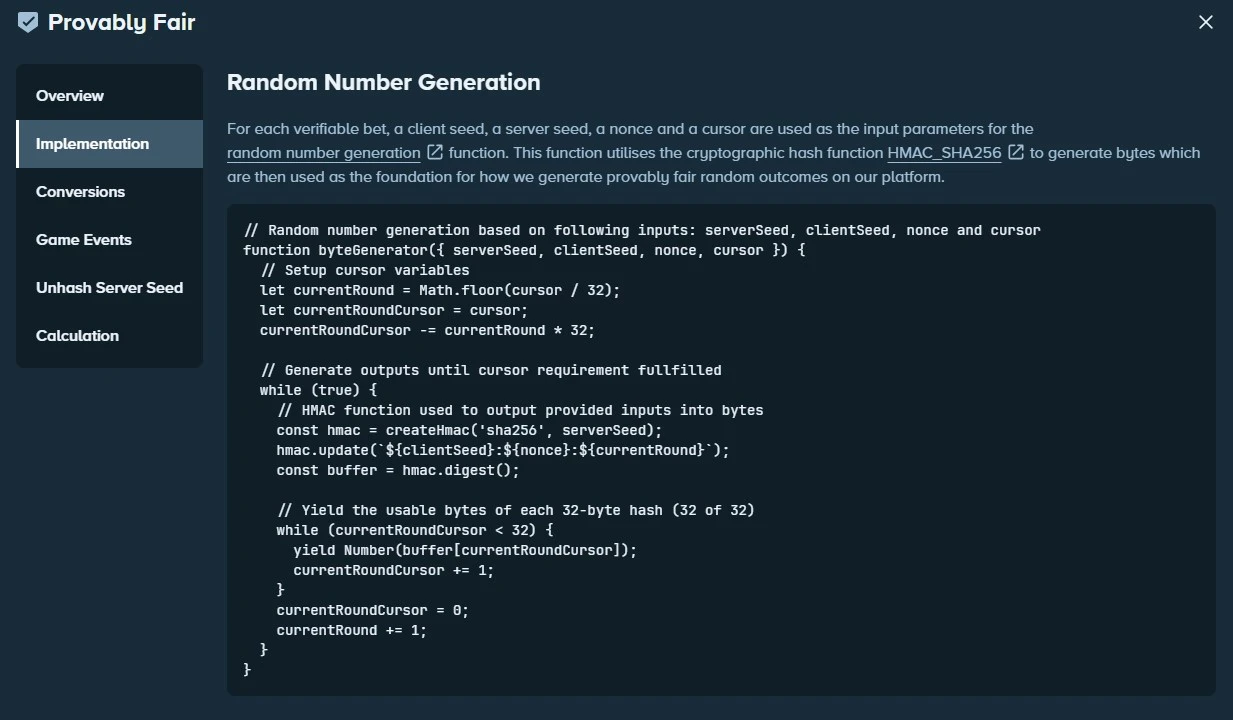
Stake's own titles — Crash, Plinko, Mines, Dice, Limbo, Keno and Hilo among them — run on a provably fair system built from a client seed you can set yourself, a server seed the casino commits to before the round and reveals afterwards, and a nonce that increments with each bet. After the server seed is revealed, you can recompute the round with a verification tool and confirm the result matches what the algorithm should have produced.
What that proves is narrower than it sounds. It shows the casino could not have altered the outcome after committing to the server seed, assuming the system is implemented correctly and you actually verify it. It does not extend to the third-party slot library, and it has no bearing on live dealer games, where fairness rests on studio controls and regulatory standards instead of cryptographic proof.
Game Selection: 10.0/10
This is Stake's strongest scored category, and the number reflects breadth rather than any single standout title. The library runs to more than 3,000 games from dozens of studios, spanning online slots, live dealer tables, RNG table games, the proprietary Stake Originals suite, and a fully integrated sportsbook and eSports betting section. Coverage this wide across this many formats is what a 9-10 band requires under our criteria, and Stake clears it comfortably.
Provider names in the library include Pragmatic Play, Evolution Gaming, Play'n GO, Nolimit City, Hacksaw Gaming, NetEnt, Big Time Gaming, Relax Gaming, Quickspin, Yggdrasil Gaming, Wazdan, Red Tiger Gaming, Playtech, and dozens more spanning slot studios, live dealer providers and table-game specialists.
RTP across the games we track
We publish per-game RTP figures where a casino makes them available. Of the 75 games we currently list for Stake, all 75 publish an RTP figure.
Metric | Figure |
|---|---|
Average RTP | 96.48% |
Highest RTP tracked | 98% — Blood Suckers |
Lowest RTP tracked | 95.97% — Gonzo's Quest |
That average, and the roughly two-point spread between the highest and lowest tracked game, is exactly the kind of gap the RTP calculator is built to price. Run any two Stake titles through it with your own session length and stake, and you get the actual cost difference between them rather than two percentages that look similar on paper. Worth flagging plainly: this figure covers the 75 titles GetABonus currently tracks RTP for at Stake, not the full 3,000-plus library — the library is far larger than what we have individually profiled so far.
Bonus Terms: 6.0/10
Stake does not run a traditional upfront deposit-match welcome bonus. Instead, the promotional structure centres on ongoing prize events — daily races, jackpots, drops and challenge-style promotions — plus a VIP programme that layers reloads and rakeback on top as your tier climbs. Where a wagering requirement does apply to promotional funds, the terms typically state around 40x on the bonus amount, which sits in the higher bracket under our bonus-terms criteria rather than the 20x-or-lower band that scores a 9 or 10.
There is a separate account-level rule worth knowing regardless of any specific promo: Stake's terms require wagering 100% of the value of a deposit before you can request a withdrawal, fiat or crypto, on that deposit. That is not a bonus wagering requirement in the usual sense — it applies to deposited funds generally — and it is easy to miss if you are only reading the terms attached to a specific promotion.
Fees on withdrawals are also left open in the terms: Stake states it may apply a withdrawal fee at its own discretion, on top of any third-party fees your bank, wallet or network charges separately. And Stake reserves the right to change or cancel bonus terms, and to cancel unclaimed bonuses after 60 days or the stated claim window, whichever is shorter — standard language for the industry, but worth reading before you commit to a promo built around a specific payout structure.
What's actually running right now
GetABonus currently lists 10 active bonuses at Stake. Most of the largest ones are prize-format offers — jackpots and drops with no deposit required and no wagering requirement attached to the prize itself — which our bonus scoring treats differently from a standard deposit match, since a prize pool has no expected value to calculate and is instead rated by our team against what it costs to enter and how the prize is distributed.
Bonus | Value | Score |
|---|---|---|
Next!: Drops | Up to $1,000,000 | 8.5 — Strong |
JAQKpot! | Up to $1,000,000 | 7.5 — Good |
All-In or Fold Jackpot | Up to $500,000 | 6.5 — Average |
Bad Beat Jackpot | Up to $1,000,000 | 6.0 — Average |
These four are examples from the full list of ten; each carries its own terms and its own score, and none of them substitute for reading the specific rules attached to the one you plan to claim. If a wagering requirement does apply to a particular promotion, running it through the bonus wagering calculator with the actual terms will tell you what it costs to clear before you commit to it.
Payment Options: 8.0/10
Stake's payment rails are built around cryptocurrency first. The site supports more than 20 digital assets for deposits and withdrawals, including Bitcoin, Bitcoin Cash, Ethereum, Litecoin, Dogecoin, Ripple, TRON, USD Coin, DAI and Tether, and states no maximum withdrawal limit on crypto payouts.
Fiat access exists but is one-directional in practice. You can buy crypto using a card, Apple Pay, Google Pay or a service like MoonPay through third-party partners, and currencies covering euros, US dollars, and dozens of regional fiat currencies are listed as supported for display and play. What you cannot do is withdraw directly to a bank account or traditional e-wallet — every payout leaves the platform as cryptocurrency, and any conversion back to fiat happens after that, outside Stake itself. That one-way gap is the main reason this category sits at 8 rather than 9 or 10: broad crypto coverage with no withdrawal cap, but a real limitation for anyone who wants a direct fiat off-ramp.
Network fees are a separate line item from anything Stake itself charges — they are set by the blockchain you withdraw on, not by the casino, and they vary with which chain you choose and how congested it is at the time. Selecting the wrong network for a given coin is one of the more common ways a crypto withdrawal goes wrong, so double-checking the network before you confirm is worth the extra few seconds.
How a crypto withdrawal actually moves
Requesting a payout at a crypto casino is not a single instant step, even when the marketing language says "instant." A typical flow runs through several stages, and understanding them helps explain why a withdrawal that is technically fast can still feel slow:
1. You submit the withdrawal request from your account. 2. The platform runs an internal review — sometimes automated, sometimes manual, depending on the amount and your account history. 3. Once approved, the platform broadcasts the transaction to the relevant blockchain. 4. The network confirms the transaction, which takes longer on some chains than others depending on congestion. 5. Your receiving wallet or exchange credits the funds — and if you are withdrawing to an exchange rather than a private wallet, the exchange's own crediting delay can add further time on top of the blockchain confirmation itself.
The most common reasons a withdrawal takes longer than expected are rarely about the blockchain itself: incomplete verification, a wallet address flagged by risk-screening tools, unfinished wagering on bonus funds, or simply requesting during a period of high platform traffic. Selecting the wrong network for a coin is a separate and entirely avoidable failure mode — always confirm the network matches what the receiving wallet or exchange actually supports before sending.
Choosing a coin and network
If you have a choice of which digital asset to deposit and withdraw with, three factors are worth weighing against each other: how fast the network confirms transactions, what the network fee looks like at the time you are transacting, and whether your receiving wallet or exchange actually supports that specific network. A cheap, fast network is only useful if the platform on the other end can actually receive it.
Stablecoins are worth particular consideration if bankroll stability matters to you. Depositing a volatile coin means the euro or dollar value of your balance can move independently of anything that happens at the tables, even across a short session — a stablecoin removes that variable, leaving only the outcome of play itself to account for.
Mobile Experience: 10.0/10
Stake runs a dedicated iOS app alongside a fully responsive mobile browser version that carries the desktop feature set — full game library, cryptocurrency banking, live chat support, all reachable without anything missing. That combination of a native app on at least one platform and a browser experience that loses nothing against desktop is what the top band in our mobile criteria calls for, and it is where Stake lands.
Live dealer streaming remains the one part of mobile play that depends more on your connection than on the platform itself, which is true of essentially every operator running live tables — a slower connection means a choppier stream regardless of how well the app is built.
Responsible Gambling: 8.0/10
Stake runs a dedicated section, referred to as Stake Smart, covering loss limits, wager limits, temporary break-in-play periods, and full account self-exclusion. Most of these are self-service and adjustable directly from account settings, which is what our criteria weight most heavily — a tool that requires contacting support to activate is a real barrier at the exact moment someone is trying to slow down.
The gap between this score and a 9 or 10 comes down to two specifics: some options, including casino-only exclusion as opposed to a full account exclusion, require a support request rather than being available directly in settings, and automatic session timers are less prominent in the tooling than the other limit types. Links to independent problem gambling support organisations are published, which is the other component our criteria check for.
If you are setting limits on Stake, do it before your first deposit rather than after a session has already gone further than planned — a limit set in advance is far more useful than one set retroactively, and Stake's Smart tools work the same way as this recommendation across most operators in the category.
Design & Usability: 9.8/10
This is Stake's second-highest score, just short of a perfect result. The interface runs a fast, dark-themed layout with a sidebar structure that keeps game categories, promotions and account tools within easy reach, and search and filtering hold up even against a 3,000-plus title library. Promotional terms are reachable within one or two clicks from the offer itself, and the site is free of the pre-ticked opt-ins, countdown pressure tactics or obscured withdrawal routes that our criteria mark down under the 1-2 band.
The 0.2-point gap to a perfect 10 is narrow enough that it reflects small friction rather than any structural problem — a genuinely clean interface with nothing engineered to push a deposit before you understand what you are agreeing to.
Customer Support
Support is not yet one of the scored categories on Stake's profile — it sits in the "reported by players" half of the rating system and needs three submitted reports before a figure publishes. It is still worth describing what is actually on offer, since availability and channel are facts you can check today, independent of how well any given dispute gets resolved.
Stake offers 24/7 live chat alongside an integrated help centre covering account questions, transaction troubleshooting, and self-service guidance on platform features. Live chat is the fastest route for most routine questions; document-heavy issues, like a verification dispute, typically move to email or ticketing instead, where evidence can be attached properly.
If you do need to raise a support case, a few things speed up resolution regardless of which casino you are dealing with: your registered username and email, screenshots of the specific issue, the transaction ID for any deposit or withdrawal involved, timestamps, and — if the issue involves a promotion — the name of the bonus and a link to its terms. A support interaction with that evidence attached from the first message tends to resolve faster than one that has to be followed up for missing details.
What Players Are Reporting: Not Rated Yet
Six categories on Stake's GetABonus profile currently show "not rated," and it is worth being direct about why rather than skipping past it: payout speed, customer support, bonus experience, and the player-side checks on game selection, mobile experience and design all require at least three submitted reports before a figure publishes. Stake currently has zero.
This is not a gap in the editorial scoring above — those eight categories are based on published terms and account tools that are the same for every visitor, and they stand independently. What is missing is the second half of the picture: whether a withdrawal that is supposed to be fast actually arrives when someone times it, whether support resolves a real dispute rather than just responding quickly, and whether the game library felt like enough once someone was actually playing rather than browsing. None of that can be estimated from a policy page, and estimating it anyway is exactly what the three-report threshold is built to prevent.
If you have played at Stake and can speak to any of these — a withdrawal you timed, a support ticket you filed, a bonus you tried to clear — that report is what turns "not rated" into an actual number for the next person reading this.
VIP Programme
Stake runs its VIP structure on wager-based progression: the more volume you put through the platform, the further you move through its tiers, and the more perks become visible. The core perk categories are cashback, periodic reload bonuses, and non-cash benefits like faster support response or withdrawal handling that can come with higher tiers, though the specifics of what any given tier unlocks are not fixed publicly and can change.
The honest framing here is that VIP is value for volume, not value for everyone. A casual player claiming the occasional prize-format promo sees limited benefit from a programme built around sustained wagering. A high-frequency player already putting significant turnover through the platform may see a real return from cashback and reload perks layered on top of play they were doing anyway.
The programme is not one of the eight scored categories, because a tier system has no fixed set of terms to compare against a one-off offer in the way a deposit bonus does — there is nothing here that reduces to a single comparable number the way a wagering requirement or a cashout cap does. What is worth checking before treating any tier as valuable: whether cashback is capped or expires, which games actually count toward it, and whether the payout timing is frequent enough to matter or delayed enough that most players forget to claim it. The tier label itself is marketing; the mechanics behind it are what decide whether it pays out anything real.
One pattern worth naming directly: VIP structures built on volume can quietly encourage playing more than you otherwise would in order to reach the next tier. If perks are not offsetting increased losses from that extra volume, the programme is working against you rather than for you — treat any VIP status as a byproduct of play you had already planned, not a reason to plan more of it.
A short checklist for evaluating any VIP tier
Before treating a VIP tier as a reason to play more, work out its actual value rather than its marketing label:
Calculate an effective cashback percentage based on what you have actually lost or wagered, not the headline rate. Check whether cashback is capped, whether it expires, and whether it carries its own wagering requirement before withdrawal. Confirm which games count toward tier progression and toward cashback — if your usual games do not contribute, the tier is worth less to you specifically than it looks on paper. Note how often rewards pay out. Weekly cashback you actually collect is worth more than a larger, delayed reward you are likely to forget about.
A tier name is marketing. The four checks above are what decide whether it pays out anything real.
Account Verification and KYC
Registration on Stake only asks for an email address, a username, and a password — no identity documents at signup. That changes once you cross certain thresholds: higher-volume betting, larger withdrawal requests, or other compliance triggers require completing Know Your Customer identity verification before the account can continue processing transactions normally.
Verification, when triggered, asks for a government-issued ID and proof of address. This is standard for the category rather than specific to Stake, and it is one of the more common reasons a withdrawal that looked instant on paper takes longer in practice — if verification is required and has not been completed in advance, the payout waits on document review rather than on the blockchain.
The practical takeaway: treat KYC as something you will likely need eventually rather than something a crypto-first platform lets you avoid indefinitely, and have documents ready before you request a withdrawal large enough to trigger a review, rather than after.
Country Availability
Stake's verdict names three specific restricted jurisdictions: the United States, the United Kingdom, and Ontario. Those are given as examples of restricted markets rather than as a complete country-by-country list, and GetABonus does not have a full published list of every restricted jurisdiction to reproduce here — where a source gives named examples rather than an exhaustive list, the honest thing to do is say so rather than fill in the rest from a guess.
Stake's own terms also state plainly that using a VPN, proxy, or similar tool to work around geo-blocking and access the platform from a restricted location is a breach of the terms of service. That is worth taking at face value rather than as boilerplate — the practical consequence of a breach like this can include account closure, voided bonuses, or withdrawal delays, and none of those are worth avoiding a legitimate eligibility check in the first place.
If your country is not one of the three named as restricted, that does not confirm eligibility either — the only reliable way to check is to view the terms and access status displayed inside the product itself before you deposit.
Pros and Cons
What works in Stake's favour:
A library of more than 3,000 games across slots, live dealer, table games, and the Stake Originals suite Crypto deposits and withdrawals across more than 20 digital assets, with no stated maximum withdrawal limit A provably fair verification system for in-house games that players can check themselves An integrated sportsbook and eSports betting section alongside the casino A multi-tiered VIP programme with rakeback for high-volume players
What counts against it:
No direct fiat withdrawal method — every payout leaves the platform as cryptocurrency A 40x wagering requirement on standard promotional offers, on the higher end of what we score well Mandatory KYC verification that triggers at higher betting volumes or larger withdrawal requests Restricted access in named major markets, including the United States, United Kingdom and Ontario A mid-band licence that provides formal registration but not tier-one-level player protections
Verdict: Who Stake Actually Suits
Stake fits cryptocurrency users and high-volume players who want a very large game library, the Stake Originals suite with its provably fair tooling, and an integrated sportsbook, and who are comfortable banking exclusively in digital assets. The mobile experience holds up well enough that a dedicated desktop session is not required to use the platform properly.
It suits you less well if you specifically want a traditional fiat welcome bonus with a straightforward deposit match, direct bank withdrawals rather than a crypto-only payout path, or you live in one of the markets where Stake does not operate. Anyone weighing regulatory comfort above everything else — wanting the strongest available player protections rather than the widest crypto-native feature set — is likely better served by a locally licensed alternative, even one with a smaller library.
None of this makes Stake good or bad in the abstract. It makes it a specific kind of platform, built for a specific kind of player, and the eight scores above are meant to let you check whether you are that player before you deposit rather than after.
What to Check Before You Sign Up
Confirm your jurisdiction is not one of the restricted markets by checking the terms displayed inside the product itself, not by assuming based on the three named examples above. If you plan to claim a promotional offer, read its specific terms — particularly the wagering requirement and what games count toward it — and run the numbers through the bonus wagering calculator before you deposit. Set deposit and loss limits through Stake Smart before your first session rather than after, and if you do withdraw, keep your transaction ID and timestamp in case verification is triggered. If you have used Stake and can report on a withdrawal, a support interaction, or how the bonus terms played out in practice, that report is what moves this review's remaining six categories out of "not rated."
Frequently asked questions
What is Stake's overall rating on GetABonus?
Stake scores 7.9 out of 10, based on eight categories checked directly by the GetABonus team against the site's published terms and tools. No player reports have been submitted yet, so the player-rated side of the score is not yet included.
What license does Stake hold?
Stake is licensed by the Curaçao Gaming Authority under license number OGL/2024/1451/0918, held by the operating entity Medium Rare N.V.
Who owns Stake?
Stake.com is owned and operated by Medium Rare N.V., which lists a head office at Seru Loraweg 17, B, Curaçao.
How many games does Stake offer?
Stake's library runs to more than 3,000 titles across slots, live dealer tables, RNG table games, the proprietary Stake Originals suite, and an integrated sportsbook and eSports section.
What is Stake's average RTP?
Across the 75 games GetABonus currently tracks RTP for at Stake, the average is 96.48%, with a high of 98% on Blood Suckers and a low of 95.97% on Gonzo's Quest.
What wagering requirement applies to Stake's promotions?
Where a wagering requirement applies to a promotional offer, the terms typically state around 40x on the bonus amount. Separately, Stake's account terms require wagering 100% of a deposit's value before that deposit can be withdrawn, in fiat or crypto.
Can I withdraw to my bank account directly from Stake?
No. Stake does not support direct fiat withdrawals — all payouts are processed in cryptocurrency, and any conversion to fiat currency happens outside the platform.
Does Stake charge withdrawal fees?
Stake's terms state it may apply a withdrawal fee at its own discretion, and separate third-party fees from your bank, wallet, or the blockchain network may also apply.
Is Stake available in the United States or United Kingdom?
No. Stake's review names the United States, United Kingdom, and Ontario as restricted markets. These are given as examples rather than a complete list, so confirm your specific eligibility inside the product before depositing.
What is provably fair, and which Stake games use it?
Provably fair is a verification system using a client seed, a server seed committed before the round and revealed after, and a nonce, letting you recompute a round's outcome after the fact. It applies to Stake's own Originals — including Crash, Plinko, Mines, Dice, Limbo, Keno and Hilo — not to third-party slots or live dealer games.
Why do some of Stake's rating categories say "not rated"?
Payout speed, customer support, bonus experience, and the player-side checks on game selection, mobile experience and design require at least three player-submitted reports before GetABonus publishes a score. Stake currently has zero submitted reports for these categories.
How does Stake's VIP programme work?
VIP progression is based on wagering volume — the more you play, the further you move through the tiers. Perks typically include cashback, periodic reload bonuses, and sometimes non-cash benefits like faster support, but specific terms vary and are not fixed publicly.
When does Stake require identity verification?
Registration itself only requires an email, username and password. Identity verification (KYC) is triggered by higher-volume betting, larger withdrawal requests, or other compliance thresholds, and requires a government-issued ID and proof of address.