Casino Bonus Calculators Explained: How to Use GetABonus Tools
Four free calculators that turn casino bonus terms, RTP percentages and bankroll math into real numbers — what each one does, why it matters, and how to use it.
A casino offer states two numbers: a percentage and a multiplier. "100% up to €500, 35x wagering" is everything the banner tells you, and neither number on its own says what the offer costs, what it is likely to pay back, or how many bets it takes to find out. The arithmetic that answers those questions is simple, but it has four or five inputs and most people are not going to sit down with a calculator app to work it out before they claim a bonus. That is the actual reason these tools exist: not to predict an outcome, but to do the arithmetic the offer itself leaves out.
This article walks through the four calculators on the GetABonus tools page — what each one is for, what every field means, how to read the numbers it gives back, and a worked example for each so the mechanics are visible rather than abstract. None of this requires a background in probability. It requires knowing what a wagering requirement multiplies, what RTP subtracts, and how to put a stake and a session length into the same sentence.
Why the Advertised Numbers Don't Tell You the Cost
A wagering requirement is a turnover condition, not a price tag. "35x" means you must stake 35 times the bonus amount before you can withdraw anything from it — it does not mean the bonus costs 35 times its value, and it does not mean you will lose that much. What it does mean is that your money passes through the game's house edge 35 times over, and each pass takes a small cut. Multiply a modest edge by a large number of passes and the cut adds up to something worth knowing in advance, not after.
RTP works the same way in miniature. A game with a 96% RTP returns 96 cents of every euro staked, on average, over a very large number of spins — which means the house edge, the part that does not come back, is 4%. On a single spin that is nothing you would notice. Staked as turnover through a wagering requirement, or through an evening's play, 4% of a few thousand euros in bets is a real number. The gap between a 94% game and a 97% game looks small as a percentage and stops looking small the moment it is converted into money over a session.
Bankroll and time follow directly from the first two. A stake per spin and an RTP together decide how many spins a bankroll survives, on average, and how long that is at a normal playing speed. None of this is difficult to calculate. It is tedious to calculate by hand for every offer, every game and every session, which is the actual gap these four tools close.
The Four Tools, and What Each One Answers
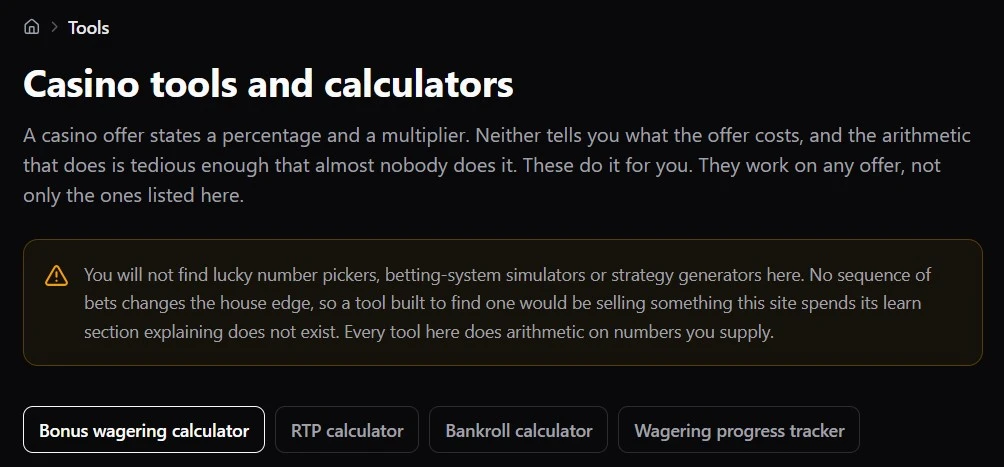
The tools page groups four calculators under one page, each one built around a different question:
The bonus wagering calculator answers: what does this specific bonus cost to clear, and what is realistically left of it afterwards? The RTP calculator answers: what does the difference between two RTP percentages cost over a session you define? The bankroll calculator answers: how many spins does this bankroll buy, and how long is that in hours? The wagering progress tracker answers: from where you already are, part way through a bonus, what does finishing actually cost?
They share the same underlying maths — turnover, house edge, expected cost — applied to four different moments in a player's decision: before claiming an offer, before choosing a game, before setting a stake, and mid-bonus when the question changes from "should I claim this" to "should I finish this." Each one works on any offer or any game, not only the ones reviewed on this site — you type in the terms from wherever you found them and the tool does the rest.
Bonus Wagering Calculator: What a Bonus Costs to Clear
The bonus wagering calculator exists to answer a single question before you claim anything: is this offer actually worth taking, given its specific terms rather than its advertised headline? A 200% match at 60x wagering can be a worse offer than a 50% match at 20x, and the percentage printed on the banner cannot tell you which — only the full set of terms run through the maths can.
When to use it
Use it before you claim an offer, and again before you decide which game to clear it on. Game weighting changes the result more than the wagering multiplier does, so the second decision is often more important than the first. Because the calculator works from whatever terms you enter, it is not limited to offers listed on GetABonus — pull the numbers from any casino's terms and conditions page and run them here first.
What each field means
Field | What it covers |
|---|---|
Type of offer | Deposit bonus, no deposit, free spins or cashback — this decides what the rest of the form asks for |
Deposit and bonus match | Deposit mode only: what you intend to deposit and the match percentage |
Bonus amount | No-deposit and cashback mode: the credit itself, with no deposit behind it |
Number of spins and value per spin | Free spins mode: how many spins and the stake fixed per spin, usually €0.10 or €0.20 |
Wagering requirement | The multiplier from the terms, entered as a plain number — 35x is 35, and 0 means no playthrough at all |
Wagering applies to | Bonus only, deposit plus bonus, or winnings — deposit-plus-bonus roughly doubles the real requirement on a 100% match |
What you play | Game weighting — slots usually count 100%, table and live games often count 10% |
Game RTP | The RTP of the game you intend to clear on, taken from that game's own page |
Stake per bet | What you plan to bet each spin or hand |
Max cashout | The cap the terms place on withdrawals from the bonus — enter 0 if the terms state no cap |
The four offer types are priced differently on purpose. A no-deposit bonus has no deposit to calculate a match from, so the form asks for the credit directly. Cashback runs the arithmetic backwards — you are being handed money back rather than money to wager forward — which is why it needs its own mode rather than being forced into the deposit-bonus fields.
Game weighting deserves particular attention because it is the field most players skip past and the one that moves the answer the most. If a bonus's terms state 35x wagering but the game you intend to play only counts 10% toward that requirement, you are not staking 35 times the bonus — you are staking 350 times it, because only a tenth of every bet counted goes toward the total. Two players clearing the identical bonus on two different games can face a tenfold difference in what they actually have to stake.
Reading the results
Result | What it tells you |
|---|---|
Required turnover | The money that must go through the game after weighting is applied — higher than the terms state whenever the game counts below 100% |
Expected cost | What staking that turnover loses on average, at the house edge of the chosen game — the number the offer itself never states |
Realisable value | The most the bonus can hand back once the cashout cap applies |
Net | Realisable value minus expected cost — negative for most offers, which is what a bonus is rather than a flaw in it |
Bets needed | Required turnover divided by your stake per bet — the plainest measure of how much play the offer commits you to |
A negative net is not a sign the calculator found a bad offer. It is what almost every bonus looks like once its cost is stated honestly, because a casino sets its terms to keep the expected cost of clearing them below what it pays out in bonus money. What the tool changes is whether you know that before you commit to 3,000 or 4,000 bets, or find it out over the course of an evening.
A worked example
Take a straightforward offer: a €100 deposit matched at 100%, giving a €100 bonus, with 35x wagering applied to the bonus only, and a game weighting of 100% because you intend to clear it on slots at a 96% RTP.
Required turnover comes to €100 × 35 = €3,500. At a 96% RTP, the house edge is 4%, so the expected cost of staking €3,500 is €3,500 × 0.04 = €140. That figure alone already exceeds the €100 bonus, before any cashout cap is applied. If the terms cap withdrawals from the bonus at, say, five times its value — €500 — the realisable value tops out at €500, and the net comes to €500 − €140 = €360 on paper. Where the cap is tighter, or the game weighting is lower, that net moves toward zero or below it quickly. Run the same offer at a 10% table-game weighting instead and the required turnover jumps to €35,000, with an expected cost that dwarfs anything the bonus can pay back — which is exactly the kind of gap the calculator is built to surface before you choose a game, not after.
Free spins and cashback price differently
Not every offer is a deposit match, and the calculator treats the other three types differently rather than forcing them into the same fields.
Free spins mode asks for a spin count and a value per spin instead of a deposit, because the money at stake is fixed by the casino before you touch it — fifty spins at €0.20 each is €10 of turnover regardless of what you would otherwise have staked. What you get back from those spins is usually credited as bonus money with its own wagering requirement attached, which is why the wagering fields still apply afterwards; the spins themselves are the starting stake, not the end of the calculation.
Cashback runs the arithmetic in the opposite direction from a deposit bonus. Instead of a percentage added to money you put in, cashback returns a percentage of money you already lost, and the wagering requirement — if there is one at all — applies to that returned amount rather than to a deposit. Entering 0 in the wagering field for a cashback offer is worth checking carefully: cashback paid as cash with no playthrough is a materially different offer from cashback paid as a further bonus that still has to be cleared, and the two can carry the same headline percentage while costing entirely different amounts to actually withdraw.
No-deposit bonuses sit closest to free spins in how the calculator treats them — a bonus amount with no deposit behind it — but they are usually the most tightly capped of the four types. A €10 no-deposit credit with a €50 maximum cashout and a 40x requirement is a small, sharply bounded offer no matter how the marketing around it is worded, and running it through the calculator is the fastest way to see that bound in actual numbers rather than reading past it.
RTP Calculator: What a Percentage Actually Costs
The RTP calculator answers a narrower but more frequent question: is switching to a higher-RTP game worth it? RTP is published as a percentage, and a percentage is a number most people read past without converting into anything concrete. Stated as the price of a session instead, the gap is usually larger than expected.
When to use it
Use it whenever you are choosing between two games, and specifically when deciding what to clear a bonus's wagering requirement on. Switching to a higher-RTP game is close to a free decision — it changes the price of play without changing the game itself, the stake, or the experience of playing it.
What each field means
Field | What it covers |
|---|---|
Spins in the session | How many spins you expect to play — 1,000 spins runs to roughly ninety minutes at a normal pace |
Stake per spin | What you bet each spin, with total turnover shown as you type |
First and second game RTP | The two RTP figures to compare, each taken from the individual game's own page |
Where a game ships in more than one RTP version, the calculator is only as accurate as the figure you enter — use whichever version the specific casino you are playing at actually runs, shown on that casino's game information screen, rather than a generic figure for the title.
Reading the results
Result | What it tells you |
|---|---|
Expected cost of the session | Turnover multiplied by the house edge (one minus the RTP) — an average over the long run, not a forecast of any one session |
Cost per hour | The same edge expressed as a rate, calculated at 600 spins an hour |
The difference | What switching between the two games saves or costs across the exact session you defined |
The table | The same session priced across the RTP bands you will actually encounter, from 94% up to 98% |
Cost per hour is usually the figure that lands hardest, because it turns an abstract percentage into something closer to an hourly rate. A four-percentage-point house edge on a one-euro spin works out to roughly €24 an hour at 600 spins an hour, regardless of what happens to appear on screen during that time.
A worked example
Over a 1,000-spin session at €1 a spin, the total turnover is €1,000. At a 94% RTP the house edge is 6%, for an expected cost of €60. At 97% the edge is 3%, for an expected cost of €30. The difference — €30 across the session — is the plain answer to "does the RTP actually matter here," worked out from the exact numbers rather than from the general sense that a higher percentage is probably better. Run the same comparison at 600 spins an hour and the two games separate into roughly €36 an hour against €18 an hour, which is a more concrete way to compare two titles than reading their RTP figures side by side.
Bankroll Calculator: How Long Your Money Actually Lasts
The bankroll calculator answers the question almost everyone asks before a session and almost nobody works out in advance: how long will this last? Because the answer is rarely calculated, sessions frequently end sooner than expected, and the gap between the two is entirely explained by stake size and house edge.
When to use it
Use it before choosing a stake, not after the bankroll is already gone. It also works as an honest way to plan a session in the first place — a spin count or a time estimate is something the maths can actually deliver, where a target like "doubling the bankroll" is not, because the calculator describes an average outcome and cannot guarantee any single session will reach it.
What each field means
Field | What it covers |
|---|---|
Bankroll | What you have set aside for the session, and are prepared to lose in full |
Stake per spin | What you bet each spin — this moves the result more than the bankroll size does, since doubling the stake roughly halves the session |
Game RTP | The RTP of the game, taken from its own page, with the house edge shown underneath as you enter it |
Reading the results
Result | What it tells you |
|---|---|
Spins on average | Bankroll divided by the expected cost of a single spin — half of all sessions end sooner than this figure, and a few last considerably longer |
Hours | The same figure converted to time, at 600 spins an hour |
Expected cost per spin | Stake multiplied by the house edge — the price of a single press of the button |
Total staked | The full turnover it takes to reach the average spin count, which is the same bankroll cycling through the game repeatedly rather than a single pass through it |
The word "average" is doing real work in this tool. Spins on average is the midpoint of a distribution, not a floor — some sessions end well before it, and a smaller number run well past it. The calculator is a planning figure, not a prediction of any specific evening.
A worked example
A €100 bankroll staked at €0.50 a spin on a 96% RTP game buys roughly 5,000 spins on average, since the expected cost per spin is €0.50 × 0.04 = €0.02, and €100 ÷ €0.02 = 5,000. At 600 spins an hour, that is a little over eight hours of average play. Double the stake to €2 a spin on the same game and the expected cost per spin becomes €0.08, dropping the average session to 1,250 spins — a little over two hours. The bankroll did not change; the stake did, and it cut the session by roughly three quarters. That relationship — stake size moving session length faster than bankroll size does — is the single most useful thing this calculator demonstrates.
Wagering Progress Tracker: Should You Finish Clearing a Bonus?
The wagering progress tracker answers a question that only comes up once you are already inside a bonus: given how far through the wagering requirement you already are, does finishing it still make sense? What the bonus cost to start no longer matters at this point — that money is committed either way. What matters is the cost of the turnover still remaining, weighed against what the bonus can still pay out once its cashout cap applies.
When to use it
Use it mid-bonus, at the point where the casino's account screen shows an amount already wagered or an amount remaining, and you want that figure converted into money and into a number of bets. It pairs directly with the bonus wagering calculator, which works out the cashout cap the bonus is capable of paying in the first place — run that one first to know the ceiling, then use the tracker to see whether the remaining cost still clears it.
What each field means
Field | What it covers |
|---|---|
Total wagering required | The bonus amount multiplied by the wagering multiplier, or the total figure the casino displays directly |
Wagered so far | The amount as the casino counts it — not necessarily what you have staked in cash, if any of it was on a game weighted below 100% |
Stake per bet | What you are currently betting, used to convert the remaining turnover into a number of bets |
Game RTP | The RTP of the game you are clearing on right now |
What you are playing | Game weighting for the current game, which multiplies whatever turnover is left |
If your casino's account screen shows an amount remaining rather than an amount wagered, subtract that figure from the total wagering required to get the number this field asks for.
Reading the results
Result | What it tells you |
|---|---|
Progress | How much of the requirement is behind you, capped at 100% — a casino counting past the requirement simply means the requirement is met |
Still to stake | The turnover left after weighting — on a game counting 10%, this is ten times the figure the casino's own progress bar implies |
Expected cost of finishing | What staking the remaining turnover loses on average — compare this against what the bonus can still pay out |
Bets left | The remaining turnover divided by your current stake — the clearest read on how much play is still committed |
Switching games mid-bonus, from something weighted at 10% to something weighted at 100%, is usually the single largest improvement available at this stage — larger than adjusting the stake, and larger than anything else short of abandoning the bonus outright.
A worked example
Suppose a bonus required €3,500 in total turnover, and the casino's account screen shows €2,000 wagered so far on a game weighted 100%. That leaves €1,500 in required turnover. At a €5 stake, that is 300 bets remaining. On a 96% RTP game, the expected cost of finishing is €1,500 × 0.04 = €60. If the bonus wagering calculator showed a realisable value of €150 once the cashout cap was applied, finishing still clears roughly €90 on paper — a case where continuing makes more sense than stopping. Change the remaining game to something weighted at 10% instead, and the required turnover to finish jumps to €15,000, with an expected cost of €600 — well past anything a capped bonus is likely to pay back, and a clear signal that the game choice for the rest of the bonus matters more than whether to keep going at all.
Common Mistakes These Numbers Catch
A few patterns show up repeatedly once terms are actually run through the maths instead of skimmed on a promotions page, and each one is the kind of thing a calculator catches immediately and a quick read does not.
Reading the wagering multiplier without checking what it applies to. A 35x requirement on the bonus alone and a 35x requirement on deposit-plus-bonus look identical on the page and are not identical in cost. On a 100% match, deposit-plus-bonus roughly doubles the real turnover required, because the base the multiplier is applied to has doubled even though the multiplier printed on the banner has not changed at all.
Picking a game without checking its weighting. This is the single largest gap between the offer as advertised and the offer as it actually plays out. A wagering requirement stated once in the terms can mean ten completely different amounts of real turnover depending on whether it is cleared on a slot counted at 100% or a table game counted at 10%, and the terms rarely put the weighting table anywhere near the headline offer.
Treating an uncapped bonus as free money. Even where the cashout cap is genuinely unlimited, the expected cost of clearing the wagering requirement does not disappear — it is simply not bounded by a cap on the upside. An uncapped bonus with a high wagering requirement and a low-RTP game behind it can still carry an expected cost that outweighs the bonus itself; "uncapped" describes the ceiling, not the price of reaching it.
Assuming a higher match percentage is automatically the better offer. A 200% match paired with 60x wagering routinely costs more to clear, in expected terms, than a 50% match at 20x — the percentage is only one of four or five inputs that decide the outcome, and it is the one most prominently advertised precisely because it is the most flattering number in isolation.
Continuing a bonus out of habit rather than checking whether it still clears. Once wagering is partway complete, the money already staked is a sunk cost either way — it does not change whether finishing is worthwhile. What decides that is the cost of the turnover still remaining against what the bonus can still pay out, which is exactly what the wagering progress tracker is built to check at that specific point rather than at the start.
Using the Four Tools Together
The four calculators are built to be used in sequence rather than in isolation, because each one answers the question that comes right after the previous one.
1. Before claiming anything, run the offer through the bonus wagering calculator with the game you actually intend to play. This tells you the required turnover, the expected cost, and what the bonus can realistically pay back once its cap applies. 2. If you are choosing between two games to clear it on, run both through the RTP calculator at the turnover the bonus calculator produced. The gap between two RTP figures, priced at that specific turnover, is usually the deciding factor. 3. Before setting a stake, run the bankroll calculator against the money you have actually set aside, separate from the bonus itself. This tells you how long a session at that stake is likely to run, so the stake you choose to clear a wagering requirement does not also empty your bankroll faster than you planned. 4. Mid-bonus, once the casino shows a progress figure, switch to the wagering progress tracker to see what finishing actually costs from where you stand, rather than from the original terms.
[[bonus:1d2c3a2e-ba9d-4bc2-8a91-8febc84dc845]]
[[bonus:7fa6e92b-08f8-41a2-b4d4-e9a8772833ef]]
Run in that order, the four tools cover a bonus from the moment it is offered to the moment it is either cleared or abandoned, with every decision along the way priced in actual money rather than left as a percentage on a banner.
What These Calculators Don't Do
None of the four tools predicts an outcome, and none of them is built to. Every result they produce is an average over a large number of bets — the expected cost, the average spin count, the average session length — and an average describes what happens over many repetitions, not what happens in the one session you are about to play. Half of all sessions at a given bankroll and stake finish before the "spins on average" figure the bankroll calculator gives you; some run considerably longer. That variation is normal, and no calculator changes it, because it comes from the game itself rather than from a gap in the maths.
The tools also do not suggest a betting system, a lucky stake size, or a sequence of bets that changes the outcome. No pattern of staking changes a game's house edge — a fixed cost, applied identically to every bet regardless of what came before it — which is why the GetABonus toolset deliberately excludes lucky-number pickers, betting-system simulators and strategy generators. A tool built to find a winning pattern would be selling something the site's own learn section spends its time explaining does not exist.
What the calculators are good for is exactly the thing an offer's own marketing leaves out: converting a percentage and a multiplier into a number of bets and an amount of money, before you commit either. That is a decision aid, not a guarantee, and it is worth treating it as one. If a session or a habit is not staying within what you set out to spend, GetABonus's responsible gambling page covers the self-service tools — deposit limits, loss limits, self-exclusion — that most licensed casinos offer directly from the account settings.
Why This Matters More at Crypto Casinos
The same maths applies at any online casino, but two things about crypto casinos make it worth running the numbers rather than skipping the step.
The first is bonus size. Crypto casinos routinely advertise larger match percentages and larger headline bonus amounts than fiat operators competing for the same players, partly because the underlying currency's volatility gives operators more room to price a promotion aggressively. A larger headline number does not change the maths behind it — a 300% match at 45x wagering still has to be run through the same calculation as a 100% match at 25x, and the larger the numbers involved, the larger the absolute gap between what a quick read suggests and what the wagering calculator actually shows.
The second is how bonus value is denominated. Where a bonus is credited in a cryptocurrency rather than a fiat amount, the euro or dollar value of both the bonus and the wagering requirement can move between the moment you claim it and the moment you finish clearing it, independent of anything the calculator accounts for. The tools on this page work in the currency figures you enter — if a bonus is stated in a coin rather than a fiat amount, convert it to the currency you are tracking your bankroll in before entering it, and treat the result as accurate to that snapshot rather than to whatever the exchange rate does afterwards.
Cashout caps are also worth checking with particular care on crypto offers, because a cap expressed as a multiple of the bonus — "5x the bonus amount" — moves in absolute terms exactly as much as the bonus itself does when denominated in a volatile asset. Running the bonus wagering calculator with the current fiat-equivalent figures, rather than the coin amount printed in the terms, is the more reliable way to see what the offer is actually capable of paying back at the point you plan to withdraw.
None of this changes the underlying formulas — turnover, house edge and expected cost work the same way regardless of what currency a casino operates in. It does mean the inputs are worth double-checking before they go into any of the four calculators, since the gap between what a crypto bonus appears to offer and what it is worth in the currency a player actually thinks in tends to be wider than the equivalent gap at a standard fiat casino.
What to Do Next
Start with whichever offer or game is actually in front of you. If you are looking at a bonus, open the bonus wagering calculator and enter its terms exactly as the casino states them — the wagering multiplier, what it applies to, and the cashout cap — before you decide whether to claim it. If you are choosing between two games for an ordinary session, the RTP calculator will tell you in under a minute whether the difference between them is worth caring about. Either way, treat the number the tool gives you as the actual price of what you are about to do, and set your stake and your session length around that price rather than around what the offer's banner implied.
Frequently asked questions
Are the GetABonus calculators free to use?
Yes. All four tools on the tools page are free, work in the browser, and do not require an account or a deposit at any casino to use.
Do I need an account or to deposit money to use these calculators?
No. Every calculator runs on the numbers you type in — the bonus terms, the RTP figures, the stake — and produces a result without needing you to sign up anywhere or hold an account at any casino.
Can I use the bonus calculator on an offer from any casino, not just ones reviewed on GetABonus?
Yes. The bonus wagering calculator works on whatever terms you enter, so you can use it on an offer from any casino by typing in the wagering requirement, match percentage and cashout cap from that casino's own terms and conditions page.
What is a wagering requirement, in plain terms?
It is a turnover condition: a multiplier applied to the bonus (or to the deposit plus bonus, or to winnings, depending on the terms) that states how much you must stake before withdrawing anything connected to the bonus. A 35x requirement on a €100 bonus means €3,500 must go through the game as turnover.
Why does the game I play change what a bonus costs to clear?
Because of game weighting. Casinos count different game types differently toward a wagering requirement — slots often count 100%, while table games and live casino often count only 10%. A lower weighting means a much larger amount of real turnover is needed to satisfy the same stated multiplier.
What does RTP actually mean?
RTP, or return to player, is the percentage of all money staked on a game that is returned to players on average over a very large number of spins. A 96% RTP means a 4% house edge — the portion of each bet that is not returned, on average.
Why does a small RTP difference matter if it's only a percentage?
Because the percentage applies to total turnover, not to a single bet. A gap of a few percentage points, multiplied across hundreds or thousands of spins in a session, converts into a real amount of money — the RTP calculator turns that percentage into that amount directly.
What does "expected cost" mean in these results?
It is the average amount a given amount of turnover is expected to lose at a game's house edge, calculated as turnover multiplied by the house edge (one minus the RTP). It describes the long-run average outcome, not a guarantee for any single session.
Can the bankroll calculator tell me how long my exact session will last?
No. It gives the average number of spins a bankroll is expected to buy at a given stake and RTP. Because it is an average, some sessions finish sooner and some last considerably longer — no calculator can predict which outcome a specific session will produce.
What should I do if the casino's account screen shows "amount remaining" instead of "amount wagered"?
Subtract the amount remaining from the total wagering required to get the figure the wagering progress tracker's "wagered so far" field asks for, then enter that.
Do these tools include betting systems or lucky number generators?
No, deliberately. No sequence or pattern of bets changes a game's house edge, so GetABonus does not publish betting-system simulators or number pickers — the calculators focus on turning stated terms and RTP figures into real costs instead.
Where can I find self-service limits if I want to control my spending while using these calculators?
GetABonus's responsible gambling page covers the deposit limits, loss limits and self-exclusion tools most licensed casinos offer directly from account settings.